Apartment nights get messy: you want a closing ritual, not another sleepy-girl mocktail that borrowed moon language from TikTok. Learning how to make moon water is the smallest version of that close — a labeled jar, a sill or balcony, and one sentence you can repeat next month.
You do not need an altar, a garden, or a crystal shop haul. You need potable water, a glass jar that actually seals, and a honest rule about what never goes in the jar.
This guide is the object stack Moon Routine uses: make the water, store it like leftovers, use it as a spray or bath, then optionally move a few drops into a sealed pendant instead of wearing an open bottle.
What moon water is, and what it is not
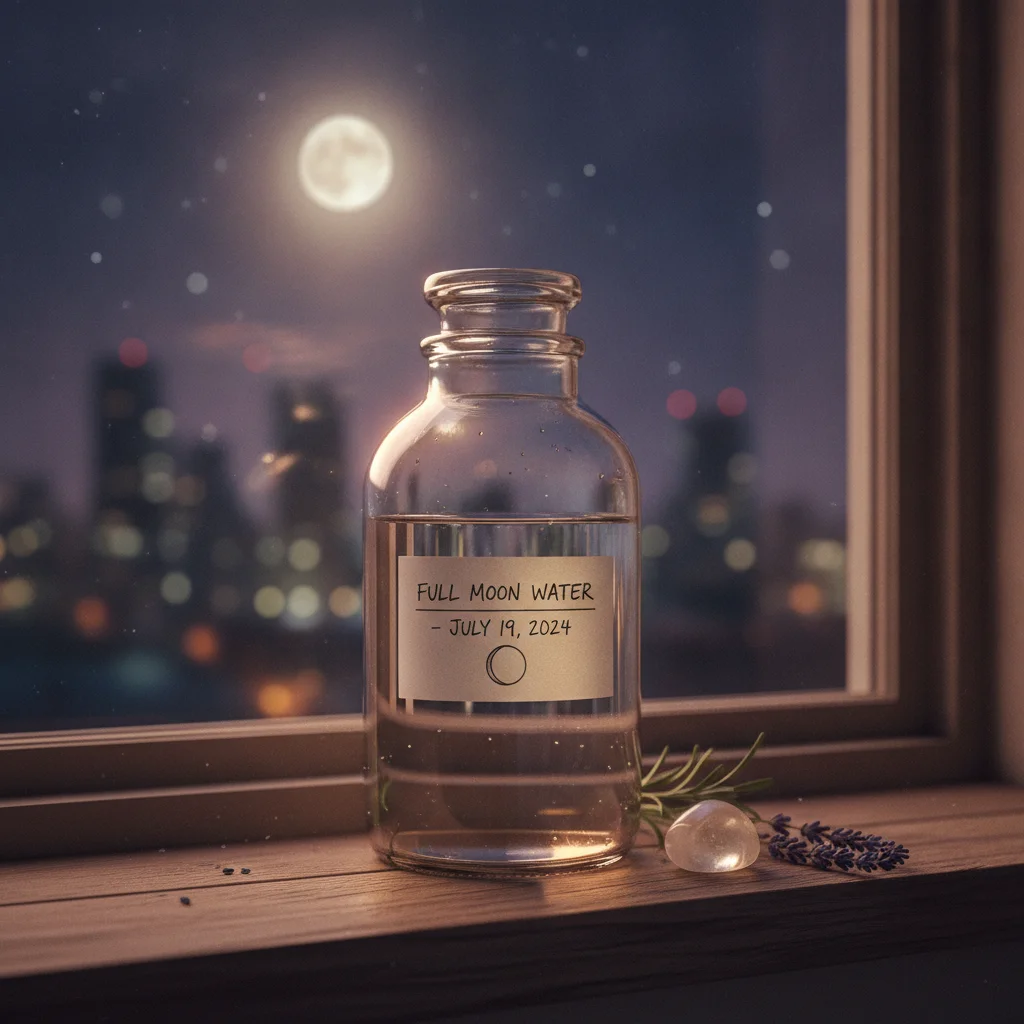
Moon water is tap or spring water left overnight under a chosen moon phase, with a written intention. The “charge” is the timed window plus the note on the jar, not a mineral that appears in the glass.
It is not a supplement. It does not replace sleep, therapy, or a magnesium drink. If a recipe asks you to swallow herbs, essential oils, or mystery crystal water, that is a different object with a different risk.
A timed jar, not a mineral drink
A useful batch is boring on purpose. Closed glass, date on the lid, moon phase on the label, no floating debris. If you cannot say what went in, do not keep it.
People abandon the practice when they expect a cinematic result on night one. The repeatable version is a 12-hour window and a one-line log. That is enough to see whether the habit is calming or just extra dishes.
Moon water is not a magnesium mocktail: one is a timed jar ritual, the other is a supplement drink with a different safety profile.
Magnesium mocktails are a different object
The sleepy-girl mocktail is tart cherry, magnesium, and social media. It has dose questions, interaction questions, and a morning-after stomach. Moon water has mold questions, stone questions, and a lid.
Keep the two on separate shelves. If you want magnesium, buy a labeled product and follow that label. If you want a lunar jar, do not hide powder in it so the ritual “does something.”
- Mocktail: ingestible supplement, measured, not moon-timed.
- Moon water: timed water, preferably unused as a drink.
- Overlap: both show up in the same TikTok night routine. That is marketing, not chemistry.
Who this method is for
It fits renters who can spare a windowsill, a fire-escape ledge, or a bathroom sill that sees night sky. It also fits skeptics who still like a closing gesture after a loud day.
It does not fit anyone expecting medical claims. Structured evening rituals can help some people feel less scattered. That is not a treatment for insomnia, anxiety, or hormone issues.
What you actually need
Buy less than the aesthetic boards suggest. A 250–500 ml glass jar with a real lid beats a wide bowl that collects dust. Distilled water is optional; clean tap water is enough if you would drink that tap on a normal day.
Skip metal tins that rust. Skip cloudy plastic that holds odor. If the only outdoor access is a hallway with no window, use the balcony, a courtyard, or an intent-only indoor shelf and say so on the label.
Glass, water, and a lid
Wash the jar with hot water and unscented soap. Rinse until it does not smell like detergent. Fill it most of the way so less headspace sits overnight, then close it.
A closed jar still “sees” the night in the folk sense people actually use: you placed it for a phase, you left it, you brought it in. An open bowl looks prettier in photos and grows a film faster in humid apartments.
- Glass mason jar or leftover jam jar with an intact seal.
- Masking tape or a waterproof label: date, phase, one intention.
- A tray so a leak does not wreck painted sills.
Optional herbs that stay out of the drink
Rosemary and lavender are the usual add-ins because they photograph well. If you want scent, keep a dry sprig next to the jar, not inside potable water. Kitchen herbs in standing water become tea, then compost, then mold.
If you still want a botanical batch for spray-only use, steep the herb in a separate cup, strain it, and never pour that into a jar you might sip. Label spray-only in large letters.
Apartment and no-sill backups
No west window is not a veto. A labeled jar on a fire-escape, a planter box, a bathroom sill, or a high shelf facing a courtyard still finishes the overnight window.
A closed glass jar on a fire-escape ledge or a bathroom sill still counts as a charge window if you leave it overnight and write one intention.
Intent-only indoor charging is allowed if you refuse to pretend the hallway fluorescent is moonlight. Write “indoor shelf, new moon, keep the job search” and treat the jar as a timer. The honesty is the ritual.
Pets and toddlers lose. Put the tray where a cat cannot knock it, and do not leave essential oils in reach. Moon water is not cat-safe just because it is “just water” once herbs or stones went in.
Overnight method, step by step
Do this on one night this month, not as a second job. The whole sequence should fit around brushing your teeth.
- Write one intention of twelve words or fewer.
- Fill and close a clean glass jar. Tape the intention and the moon phase on the side.
- Set the jar outside or on the chosen sill before you sleep.
- Bring it in after sunrise. Dry the outside. Refrigerate if you will keep it.
- Optional: move a few drops into a sealed vial, then wear or store that vial. Do not wear an open bottle of standing water.
Set the jar before you want to sleep
Pick the intention before the water hits the glass. “Feel better” is too wide to notice later. “Stop reopening the argument in my notes app” is specific enough to check in two weeks.
New moon water intentions belong on a new moon jar. Full moon water ritual language belongs on a full moon jar. Do not relabel yesterday’s batch because the internet said today’s moon is prettier.
How long to leave it out
Overnight is the working window: roughly dusk to first indoor hour after sunrise. You do not gain a better batch by leaving it three days on a hot ledge. You gain algae, curious insects, and a smell.
Direct noon sun the next day is optional and often unhelpful. Some stones fade; labels peel; apartments overheat. If you want a “sun finish,” keep it under an hour and skip it for any dry-charge stone sitting nearby.
Rain is a lid test, not a blessing. A closed jar can stay. An open bowl becomes roof runoff. Bring open vessels in.
A same-night vial or bracelet close
If you already own a sealed moon water necklace, this is the night to fill it from a fresh, closed, stone-free jar. Wipe the vial threads. Do not overfill. Cap it until it is actually sealed, then wipe again.
The wearable object is not a second open reservoir. Compare an open bottle versus a sealed vial pendant before you hang anything against skin. For the fill-and-wipe sequence, use how to charge a moon water vial pendant.
A moonstone or clear-quartz bracelet can sit beside the jar on a dry plate. That is the same-night script without soaking elastic or metal findings. If you will wear a filled vial daily, read whether moon water jewelry is safe to wear daily before you sweat in it.
Full-moon vial owners who already have a necklace can follow the charge night in how we charge a vial necklace on the full moon instead of inventing a second method.
Moon phases, eclipses, and nights to skip
Phase matching is a planning tool. It stops you from making seven jars because every TikTok used a different caption. One jar per cycle is plenty.
| Night | Use the jar for | Skip if |
|---|---|---|
| New moon | Start a habit, name a goal, first-time batch | You already have an unopened jar from last month |
| Waxing | Continue a project you already started | You are only making water because the app pinged |
| Full moon | Close a cycle, charge a sealed vial, release work after you write it down | The jar would sit in a party, a fire pit, or a crowd |
| Waning | Let-go lists, cloth rinse, “do not keep this” objects | You wanted manifestation language and grabbed the wrong night |
| Lunar or solar eclipse | Do not make a drinking or wearing batch | Always, for this method |
New moon versus full moon water
New moon water is a start line. The intention is a seed, not a verdict. Full moon water is a checkpoint: what ended, what you are done rehearsing, what you will not text.
Moon water manifestation talk usually belongs on waxing or new batches, and even then it is a calendar, not a contract. If nothing “happened,” you still have a labeled jar and a log line. That is the useful data.
Waning nights for release work
Waning water is for lists you will not keep on your phone. Write the thing, rinse a cloth, wring it into the shower drain, dump the jar within a week. Do not gift waning water as a cute bottle.
Why eclipse batches are a no
Eclipse content sells intensity. Intensity is a bad storage plan. You do not need folklore about “chaotic energy” to skip it: the night is easy to over-ritualize, people leave jars out too long, and the leftover water still has to live in your fridge.
Skip eclipse nights for moon water; the light is not a brighter full moon, and the leftover jar is the part you have to live with.
If an eclipse falls on your favorite full moon, wait a night or use the next clear waxing evening. Missing one cycle is cheaper than a jar you do not trust.
Storage, mold, and seven uses that are not drinking
Treat the jar like cooked leftovers. Fridge, closed, dated, dumped at the first off smell. Room-temperature moon water on a sunny counter is a science fair for biofilm.
Do not freeze-thaw in a glass jar with a tight lid unless you left headspace and accept the risk of a cracked jar. Ice does not make the ritual stronger.
Fridge life and spoilage signs
Three days is a comfortable window. Seven days is the outer edge for a closed, stone-free, herb-free jar. After that, dump it even if it looks fine.
- Cloudiness that was not there at sunrise.
- Rainbow film, fuzz, or specks that move.
- Sour, pond, or detergent smell.
- A lid that pops or hisses.
When in doubt, pour it on a hardy outdoor plant or down the drain, wash the jar, and stop. Do not “refresh” by topping up with new water. That is how you keep the old colony.
Crystal and herb add-ins with a safety table
Most stones do not belong in water. Some dissolve, some leach metals, some are glued or dyed. Dry-charge on a plate next to the jar.
| Item | In the water? | Why |
|---|---|---|
| Clear quartz, moonstone (tumbled, not cracked) | Optional, still better dry | Usually stable; inspect for coatings |
| Selenite, desert rose | No | Soft, water-soluble gypsum |
| Malachite, azurite | No | Copper minerals; not a soak |
| Pyrite, hematite, pyrrhotite | No | Can rust, crumble, or shed |
| Halite, calcite, fluorite | No | Soft or soluble |
| Raw copper, dyed howlite, glued clusters | No | Unknown coatings and metals |
| Rosemary, lavender, rose petals | Not in a sipping jar | Becomes perishable tea |
| Essential oils | No | Not water-soluble; skin and pet risk |
If a listing will not name the mineral, it does not go in water. “Aura” coatings and “galaxy” stones are surface treatments. Keep them on the dry plate.
Spray, plants, bath, and cloth
Drinking is the loudest use and the weakest one for this site. Prefer uses that do not require you to ingest standing water.
- Room spray: strain nothing if the jar was closed and stone-free; use within three days.
- Pillow or linen mist: light spray, not soaking, unscented.
- Houseplant rinse for hardy plants: skip edible herbs you will eat this week if the water is old.
- Bath add-in: pour the jar into the tub, not into your mouth.
- Cloth wipe for tools or a journal cover: wring out, then wash the cloth.
- Altar or sill wipe-down on the next new moon: then dump the rest.
- Sealed vial fill: a few drops, wiped threads, then wear or store.
Do not spray faces, contacts, open cuts, or pets. Do not use eclipse jars, moldy jars, or mystery-stone jars on skin.
Mistakes that waste a batch
The competitor pattern is a mason-jar photo, a rosemary sprig, and no storage paragraph. The mistakes below are how those posts age in a real kitchen.
Open plastic and mystery stones
Plastic absorbs odor and scratches. Open bowls collect dust and insects. A pretty amethyst cluster from a mall kiosk can be heat-treated, glued, or both. Dry plate or nothing.
Using every jar the same way
A new moon start-line jar is a poor match for a breakup list. A waning dump jar is a poor match for a necklace fill. Label the job on the glass so you do not drink the release batch by accident.
Skipping the one-line log
Date, phase, location (sill / balcony / indoor shelf), stone or no stone, and mood the next evening. Three cycles of that log tell you more than a 4,000-word roundup. If the log is always “forgot the jar until Thursday,” shorten the ritual, do not buy more crystals.
Frequently Asked Questions
How do you make moon water for the first time?
Fill a clean glass jar, write one intention on a label, set it where night sky or night air can reach it, and leave the lid on. Bring it in after sunrise and refrigerate if you plan to keep it more than a day.
Which moon phase is best for charging water?
Use a new moon jar to start a habit or name a goal. Use a full moon jar to close a cycle or charge a sealed vial. Waning nights fit release work. Skip eclipses.
Can you drink moon water?
Only if the water started potable, the jar stayed closed, no toxic stones or mystery herbs went in, and you treat it like leftover drinking water. Most Moon Routine uses are spray, bath, plants, and cloth. This is not medical advice.
How long does moon water last in the fridge?
Plan on three to seven days in a closed glass jar. Dump it at cloudiness, film, odd smell, or any visible growth. Do not top up a stale jar.
Which crystals are unsafe in moon water?
Keep selenite, malachite, pyrite, hematite, halite, and most raw copper or dyed stones out of water. Charge those dry on a plate next to the jar. Moonstone and clear quartz are the usual in-jar pair if you insist on a stone.
Your Next Step on the Lunar Path
Pick one night this cycle. Fill one closed jar. Write one intention. In the morning, either dump it into a bath or move a few drops into a sealed pendant — not both, not seven jars.
If you want the wearable version after this batch, start with the necklace buying guide, then the vial charge steps. Keep magnesium drinks in the kitchen and moon jars on a dated shelf. That split is the whole practice.